Autonomous Vehicles and Smart Transportation 2026: Toward a Driverless Future
Autonomous vehicle technology 2026: Level 4 self-driving cars, lidar and computer vision, robotaxi services, autonomous trucking, V2X communication, regulation and societal impact.
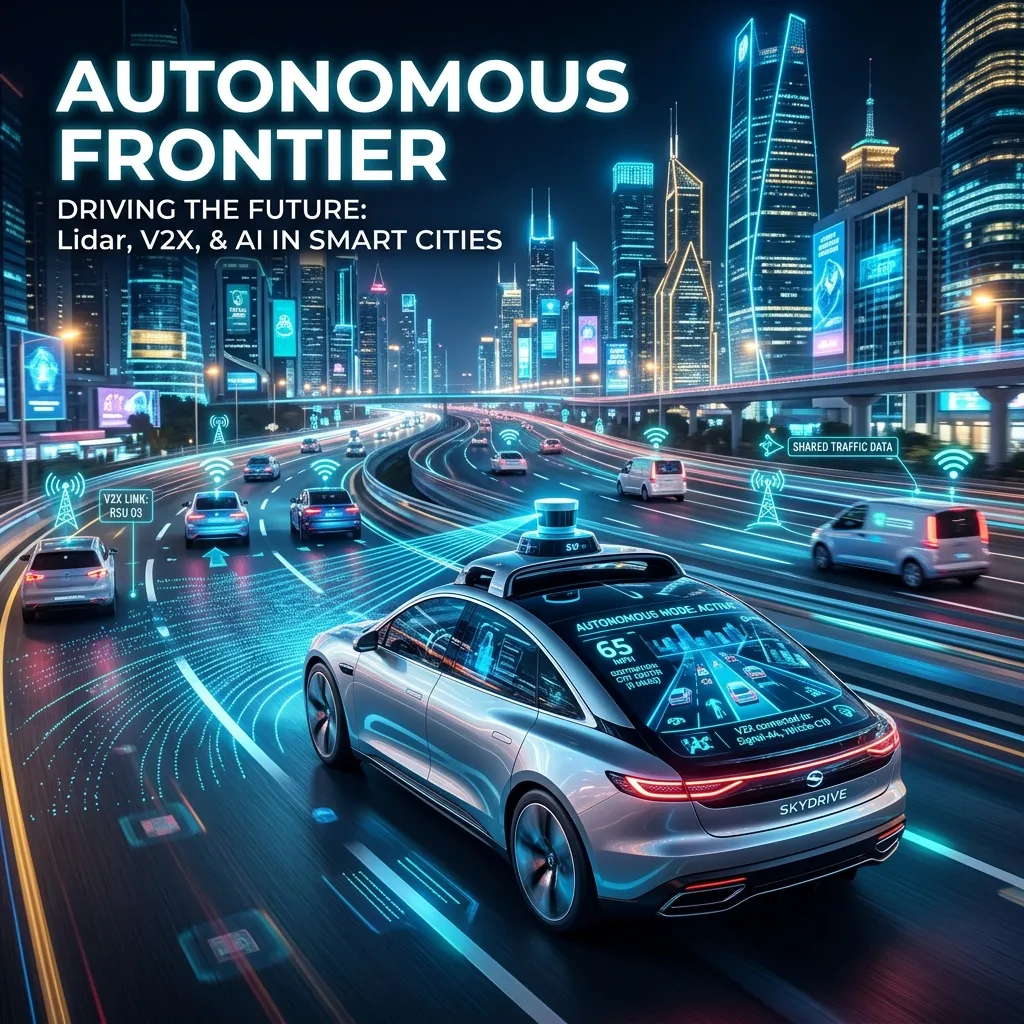
Autonomous vehicle technology is no longer science fiction in 2026, it’s starting to become a part of daily life. The fact that Waymo offers commercial robotaxi services in many US cities, that autonomous trucking is beginning to transform the cargo industry, and that driverless vehicles are becoming widespread in China’s major cities are concrete evidence that this technology has matured.
Autonomous Driving Levels
Six levels of autonomous driving defined by SAE (Society of Automotive Engineers) measure the maturity of the technology.
Level 0, no driver assistance, the vehicle is completely human-controlled. Level 1 offers one dimensional assistance: adaptive cruise control or lane keeping assist. Level 2 offers assistance in multiple dimensions: automating speed and steering control together. In 2026, the majority of new vehicles will have at least Level 2 features.
Level 3 offers conditional automation, allowing the vehicle to take full control in certain scenarios (motorway driving, traffic congestion) and the driver to intervene only when the system requests it. Mercedes-Benz and BMW have Level 3 certification in some motorway scenarios.
Level 4 offers fully autonomous driving in a limited geographical area. There is no need for a human being in the driver’s seat. Waymo and Cruise’s robotaxi services are at Level 4. In 2026, Level 4 vehicles operate commercially in defined geofenced areas in certain cities.
Level 5 means fully autonomous driving in all conditions and everywhere. This level is not yet commercially available and is targeted for the 2030s.
Detection Technologies
Autonomous vehicles combine multiple sensor technologies to sense their environment.
LiDAR (Light Detection and Ranging) creates a three-dimensional map of the environment by sending laser beams. By 2026, LiDAR costs have dropped tenfold and their size has become small enough to be embedded in the vehicle body. Solid-state LiDAR has become the standard of the automotive industry with its durable structure that contains no moving parts.
The cameras work with computer vision algorithms to identify traffic signs, lane markings, pedestrians and other vehicles. Tesla’s “vision-only” approach is controversial, but offers a cost advantage.
Radar provides reliable distance and speed measurement in bad weather conditions (rain, fog, snow) when the performance of other sensors decreases.
Ultrasonic sensors are used to detect close-range obstacles, especially in parking scenarios.
Sensor fusion combines data from all these sensors to create a consistent and reliable model of the environment. The error of a single sensor is compensated by other sensors.
Robotaxi Services
Waymo offers commercial robotaxi service in San Francisco, Phoenix, Los Angeles and Austin in 2026. Users call a ride via the smartphone application, the driverless vehicle arrives, the journey is completed and payment is made automatically.
The economic model of the robotaxi service promises lower costs in the long term compared to traditional taxi and ride-sharing services. Driver cost, the taxi service’s largest cost item, is eliminated. However, vehicle cost, technology maintenance and insurance costs are initially high.
In terms of safety, autonomous vehicles have accumulated millions of miles of test data. The number of accident-free miles Waymo has driven is several times higher than the average for human drivers. However, public trust is still not fully established, high-profile accidents generate significant media coverage.
Autonomous Truck Transportation
Autonomous truck transportation is considered as the field expected to reach profitability on a commercial scale before robotaxi. Long-distance highway driving offers a much more predictable and structured environment than urban driving.
Platooning (convoy) technology enables more than one truck to drive in a convoy at very close distances, providing fuel savings and increased capacity. While the front truck is controlled by the human driver, the rear trucks follow autonomously.
The hub-to-hub model envisages autonomous trucks driving between transfer centers on the highway, while last-mile deliveries are carried out by human drivers. This model maximizes economic benefit while reducing technological difficulty.
V2X Communication
Vehicle-to-Everything (V2X) communication enables vehicles to communicate with each other (V2V), infrastructure (V2I), pedestrians (V2P), and the cloud (V2N).
With V2V communication, vehicles instantly transmit brake, speed change and direction information to each other. A vehicle’s sudden braking is signaled to the vehicle behind it within milliseconds, at speeds far beyond human reaction time.
With V2I communication, traffic signals transmit green wave timing to vehicles. When the vehicle predicts the approaching red light, it optimizes its speed, saving fuel and reducing unnecessary stops.
Social and Economic Impact
The social impact of autonomous vehicles is multidimensional. Considering that more than ninety percent of traffic accidents are caused by human error, autonomous driving could potentially save millions of lives.
The employment impact is one of the biggest societal concerns. Taxi drivers, truck drivers, and courier drivers,professions that affect millions of people will be transformed. But new job categories will also emerge, such as autonomous vehicle engineer, fleet manager, and remote surveillance operator.
From an urban planning perspective, autonomous vehicles could dramatically reduce the need for parking space. When vehicles are constantly in motion, large parking areas can be converted into parks, green spaces or housing.
Regulation Framework
Autonomous vehicle regulation is still in development in 2026. There are different regulations on a state-by-state basis in the US. The EU is working on a comprehensive legal framework for autonomous vehicles. There is no specific autonomous vehicle regulation in Türkiye yet.
The insurance model differs fundamentally in autonomous vehicles. Accident liability shifts from the driver to the manufacturer and software developer. This paradigm shift requires a complete restructuring of the insurance industry.
IPEC Labs and Intelligent Transportation
As IPEC Labs, we implement smart transportation technologies directly in the service tracking module in our Smart School Ecosystem. GPS-based real-time location tracking, safe zone management with geofencing, automatic boarding-departure detection and parent notification system, these modules are the steps to translate the infrastructure requirements of the autonomous vehicle era into practice in the education sector. As V2X communication standards mature, we plan to integrate the next generation of applications in school bus security.
Subscribe to our newsletter!