NZeca AI: The Story Behind 97.1% Accuracy in Turkish Natural Language Processing
Technical architecture of Turkey's native AI model NZeca AI, 97.1% accuracy in Turkish NLP, unlimited context window, code generation, image analysis and education sector applications.
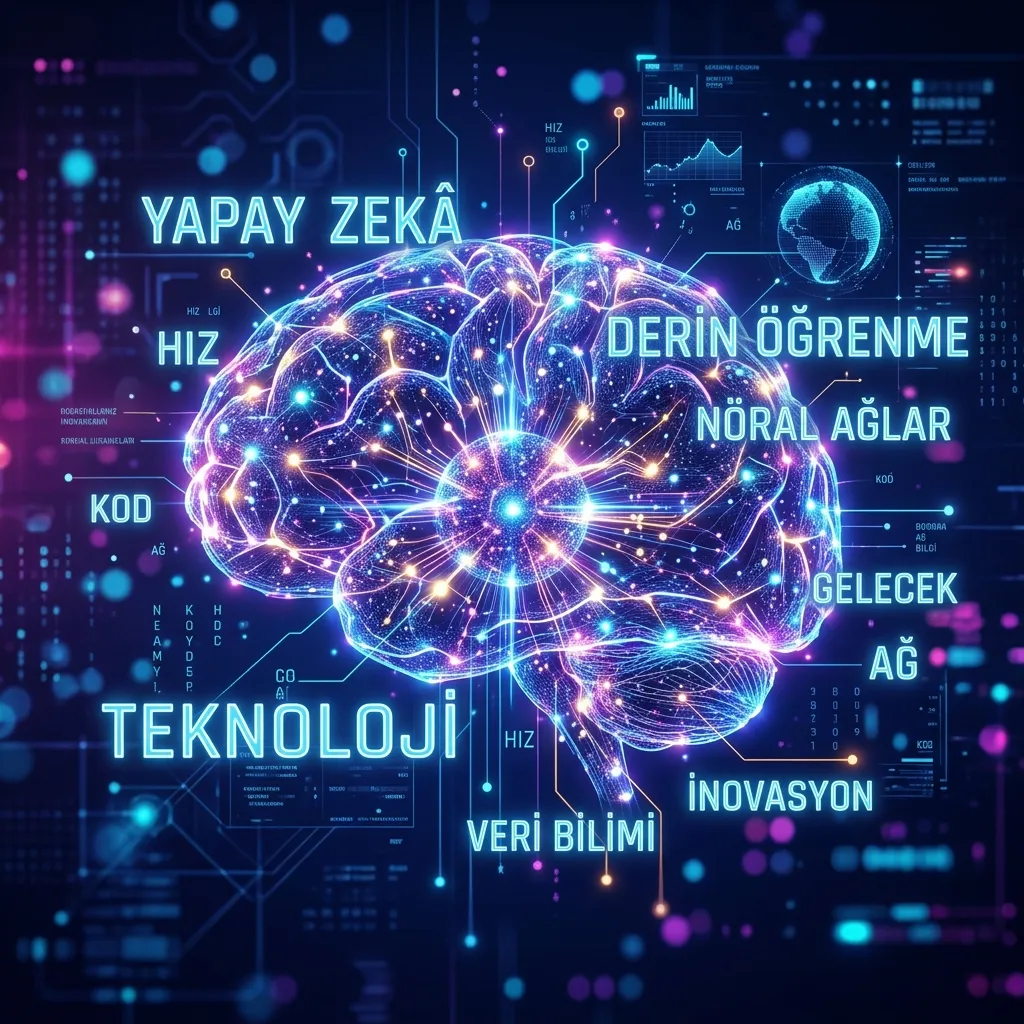
Turkish is one of the most challenging languages in the world of artificial intelligence. Its agglutinative structure, rich morphology and layers of meaning that change depending on the context are the main reasons why global AI models fail in Turkish. As IPEC Labs, we have developed a radical solution to this problem: NZeca AI, A domestic artificial intelligence platform that reaches a 97.1% success rate in Turkish natural language processing, has unlimited context windows, can generate code and perform image analysis.
Why is Turkish Difficult for Artificial Intelligence?
Global AI models are developed with English-centric training data. English has a relatively simple morphology: words usually take few suffixes, the syntax follows fixed rules. Turkish is completely different.
The agglutinative structure of Turkish allows extremely complex meanings to be created by adding more than one suffix to a single word. While the word “from their houses” is expressed as four words in English, it is a single word in Turkish. Examples such as “Those we could not make Czechoslovakian” show how deep Turkish morphology can be.
Vowel harmony rules are phonetic patterns specific to Turkish and determine which vowel the suffixes take. Correct application of these rules is the basic element that makes the text natural and fluent. Global models often miss these subtleties.
Regarding context sensitivity, the same word in Turkish can have completely different meanings in different contexts. The word “face” can be a number, a body part, or a verb. The word “prairie” can mean area, color, or verb. This polysemy makes it necessary for NLP models to analyze the context correctly.
Technical Architecture of NZeca AI
NZeca AI is a transformer-based large language model designed for Turkish from scratch. The basic components of its architecture are as follows.
The unlimited context window is NZeca’s most important technical innovation. Traditional models are limited to 4K, 8K or 32K tokens. NZeca offers theoretically unlimited context windows thanks to dynamic memory management and KV cache compression technologies. This means that long documents, books or entire code bases can be analyzed.
When it comes to multimodal capability, NZeca doesn’t just process text. Can perform image analysis, examine a photo and produce a detailed description. Can perform code generation and analysis, can write code in languages such as Python, JavaScript, TypeScript, SQL, examine the existing code and detect errors. Can provide mathematical solutions, solve complex equations step by step.
Regarding tokenizer, NZeca uses a tokenizer developed specifically for Turkish. Tokenizers of global models over-fragment Turkish words. For example, while the word “from your teachers” can be divided into five-six parts by a global tokenizer, NZeca’s tokenizer processes it in two-three parts. This is a critical advantage in terms of both speed and accuracy.
Training Data and Methodology
A rigorous training process lies behind NZeca’s 97.1% success rate.
During the data collection phase, a corpus consisting of the largest and highest quality text collections in Turkish was created. Academic articles, works of literature, news texts, technical documentation, legal texts, and colloquial language,different linguistic registers were all represented.
The data cleaning phase is the most laborious process. Duplications were removed, low-quality texts were filtered, personal data was anonymized. Data quality is a direct determinant of model quality.
During the fine-tuning phase, the model was fine-tuned for industry-specific tasks. He specialized in areas such as teaching assistantship on the Ministry of Education curriculum, code production for software development, and professional text writing for the business world.
In the RLHF (Reinforcement Learning from Human Feedback) phase, human raters scored the model’s responses. Model behavior was optimized according to accuracy, fluency, usefulness and security criteria.
NZeca’s Role in the Education Sector
As the AI assistant in our Smart School Ecosystem, NZeca offers revolutionary applications in the field of education.
As a student support system, NZeca works like a personal tutor, adapting to each student’s individual learning pace and style. It explains mathematical problems step by step, provides guidance in writing compositions in Turkish, visualizes experiments in science, and offers foreign language practice.
As a teacher assistant, NZeca automates time-consuming tasks such as creating lesson plans, generating exam questions, preparing worksheets and writing student performance reports. It reduces teacher workload by forty to sixty percent, allowing educators to focus on direct student interaction.
As a parent communication tool, NZeca automatically generates progress reports for teachers to send to parents. Each student’s strengths, areas for development, and suggestions are presented in a structured format.
Competitor Comparison
When we compare NZeca’s Turkish NLP performance with global competitors, the difference is striking. On text comprehension tasks, NZeca achieves ninety-seven point one percent, while the closest global competitor remains around eighty-nine percent. While NZeca’s fluency score in Turkish text production is nine point two out of ten, global models are around seven point five. In code generation, NZeca stands out in terms of consistency in code generation with Turkish explanations.
The main reason for this difference is that NZeca was designed from scratch for Turkish. While global models treat Turkish as “one of the supported languages”, NZeca positions Turkish as its primary and priority language.
API and Integration
NZeca AI is offered as an integrable platform via RESTful API. Developers can add Turkish NLP capability to their applications with a few lines of code.
The API offers endpoints such as text completion, question and answer, summarization, translation, sentiment analysis, text classification and code generation. Each endpoint has detailed documentation and sample codes.
Pricing is token-based and operates on a pay-as-you-go model. A free tier is offered for small projects. Special pricing and SLA guarantees are available for corporate customers.
Future Roadmap
Future plans for NZeca AI include real-time voice recognition and synthesis, video analysis and annotation generation, support for more programming languages, industry-specific fine-tuned models, and the ability to run on-device with edge deployment.
Conclusion
NZeca AI is the most concrete product of Türkiye’s artificial intelligence vision. It is a constantly evolving platform that understands the complexity of Turkish, can be used in a wide range of areas from education to software development. As IPEC Labs, we are determined to make NZeca the global standard setter of Turkish AI.
Subscribe to our newsletter!