IoT and Smart Cities: Building Future Infrastructure with the Internet of Things
IoT technology fundamentals, sensor networks, MQTT and CoAP protocols, smart city applications, industrial IoT, energy management, security challenges and edge computing.
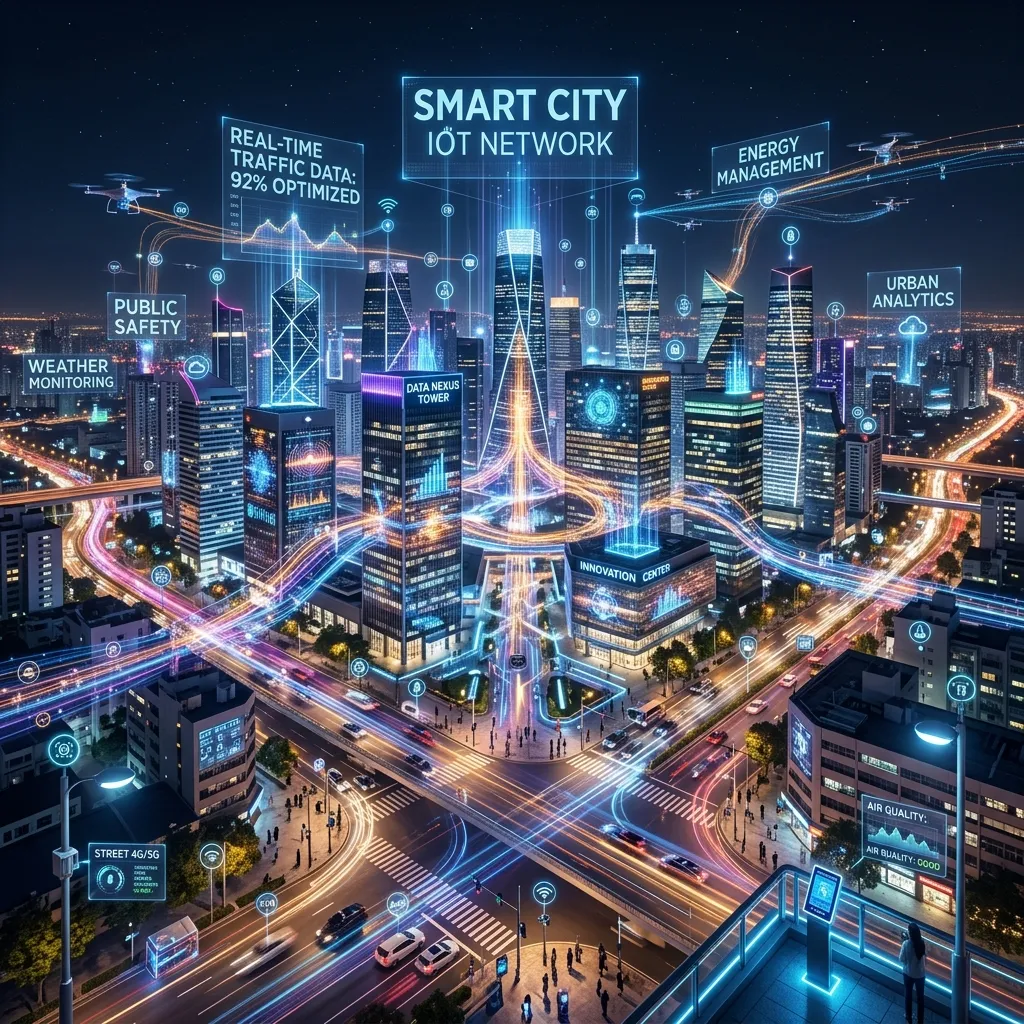
The Internet of Things (IoT) is the technology ecosystem that enables physical objects to collect and share data through sensors, software, and network connectivity. By 2026, more than 40 billion IoT devices will be active worldwide, and this number is increasing exponentially every year. From the smart thermostat at home to industrial sensors in factories, from traffic management systems in cities to soil moisture sensors in the field, IoT has penetrated every aspect of life.
Fundamental Layers of IoT Architecture
The IoT system consists of four basic layers. Each layer creates the value chain by transferring data to the next layer.
The sensing layer consists of sensors that collect data from the physical world. Temperature, humidity, pressure, light, motion, location, sound, image and chemical sensors convert environmental data into digital. Miniaturization and cost reductions in sensor technology are the key drivers of IoT proliferation. While a temperature sensor cost a few dollars in 2010, it will cost a few cents in 2026.
The network layer ensures that data collected from sensors is transmitted to the cloud or edge servers. Different communication protocols such as WiFi, Bluetooth Low Energy (BLE), Zigbee, LoRaWAN, NB-IoT and 5G offer solutions suitable for different scenarios.
WiFi is ideal for devices that require high bandwidth and access to a power source. BLE is suitable for short distance applications that require low power consumption. LoRaWAN is designed for applications that require long-distance communications at low data rates, it can deliver miles of range with a single gateway. NB-IoT and 5G were developed for wide area IoT applications using mobile operator infrastructure.
The processing layer transforms the collected raw data into meaningful information. Filtering, combining, analyzing and storing data occurs in this layer. While cloud platforms (Google Cloud IoT, AWS IoT Core, Azure IoT Hub) provide centralized data processing, edge computing offers local processing near the device.
The application layer consists of dashboards, alert systems, automation rules and reporting tools that present processed data to users. Users interact with IoT systems through this layer.
MQTT: Standard Protocol of IoT
MQTT (Message Queuing Telemetry Transport) is the most common messaging protocol in the IoT world. It is lightweight, reliable and can operate at low bandwidth, making it ideal for IoT.
The publish-subscribe model forms the basis of MQTT. Devices (publishers) publish messages to specific topics (topics). Relevant applications (subscribers) receive messages by subscribing to these topics. This model allows thousands of devices to communicate efficiently without requiring a direct connection.
QoS (Quality of Service) levels determine message delivery reliability. QoS 0 is the fastest but least reliable, QoS 1 provides an at least once delivery guarantee, QoS 2 provides an exactly once delivery guarantee.
Smart City Applications
Smart city is a concept that optimizes city services with IoT sensors and data analytics. By 2026, hundreds of cities around the world have implemented smart city projects.
Intelligent traffic management dynamically adjusts signal durations by analyzing real-time traffic data. It improves traffic flow by giving longer green light times to busy directions. The signals automatically clear the way when emergency vehicles approach.
Smart lighting allows street lights to be automatically controlled with motion sensors. When there is no passage of people or vehicles, the lights are dimmed to save energy. Forty to sixty percent energy savings are reported.
Smart parking systems detect empty parking spaces with sensors and direct drivers. The time to search for a parking space is reduced by an average of thirty percent, resulting in fuel savings and emission reductions.
Smart waste management optimizes collection routes with occupancy sensors in garbage containers. By prioritizing full containers, it reduces unnecessary trips and lowers collection costs.
Water management and leak detection detects water leaks in real time with pressure and flow sensors placed throughout the network. Early detection of leaks prevents water waste and minimizes infrastructure damage.
Industrial IoT (IIoT)
Industrial IoT is used for machine monitoring, predictive maintenance, quality control and process optimization in manufacturing facilities.
Predictive maintenance analyzes the vibration, temperature and sound data of the machines and gives warnings before failure. Unplanned downtimes can be reduced by thirty to fifty percent. The cost of an unplanned downtime in a factory can be tens of thousands of dollars per hour, an early warning system provides protection against this cost.
A digital twin is a virtual copy of a physical entity. The digital twin, constantly updated with data from IoT sensors, is used for simulation and optimization. Different scenarios can be tested on a digital twin of a production line, without touching the physical line.
Edge Computing and IoT
The volume of data produced by IoT devices has reached enormous levels. Sending all this data to the cloud is not sustainable in terms of both cost and latency. Edge computing solves this problem by moving data processing from the cloud closer to the device.
The advantages of edge computing are obvious. It provides low latency because data does not go to remote servers. It saves bandwidth because only processed and filtered data is sent to the cloud. It provides offline operability because local processing continues even if the internet connection is lost. It ensures data privacy because sensitive data does not leave the device.
IoT Security Challenges
IoT devices create a large attack surface for cyberattacks. Many IoT devices have limited processing power and cannot run complex security protocols. Not changing default passwords, neglecting firmware updates, and not using encryption are common vulnerabilities.
The Mirai botnet attack is the most striking example of how critical IoT security is. Hundreds of thousands of insecure IoT devices have been compromised and large-scale DDoS attacks have been carried out.
IoT security best practices include: unique authentication for each device, end-to-end encryption, regular firmware updates, isolating IoT devices from the main network with network segmentation, and anomaly detection with continuous monitoring.
IPEC Labs IoT Applications
As IPEC Labs, the IoT modules in our Smart School Ecosystem, facial recognition input-output, palm payment, energy monitoring, service GPS tracking and hygiene sensors, are concrete applications of all the above-mentioned IoT principles in the education sector. On-device facial recognition with Edge AI, transmission of sensor data to the central panel with MQTT, and protection of student data with layered security architecture, all these are the result of meticulous implementation of IoT best practices.
Subscribe to our newsletter!